Most photographers don’t have a marketing problem.
They have a “nobody can tell what I shoot” problem.
If you want to know how to get more photography clients, the short answer is that you make it obvious what you shoot, obvious what it costs, and obvious what to do next. And then you ask the people who already hired you to send someone else. That’s most of it. Everything below is detail.
I’m not a photographer. I build websites, and a fair number of them are for photographers, so I’ve spent a lot of time looking at the exact moment where somebody who was interested in hiring you quietly decides not to.
It is almost never the photos.
Why do good photographers get so few inquiries?
Because the work is buried.
The typical photographer’s site opens with a full-screen slideshow of eleven images from six different genres: a wedding, a product shot, a headshot, somebody’s dog, a moody landscape, and one photo of a wedding cake taken at an angle that suggests it was a hostage situation.
Then a menu with nine items. Then a paragraph about your journey.
Somewhere down there, in gray text on a slightly different gray, is how to contact you.
The visitor’s actual thought is:
“Wait… do you even shoot what I need?”
They don’t email to find out. They close the tab and open the next photographer. You never see it happen, which is exactly why it keeps happening.
Being a generalist is fine as a business. It’s fatal as a first impression. Clients pick the photographer who looks like the best at the specific thing they need, not the one who is competent at nine things.
What should a photography website actually do?
Three things, in order, and nothing else on the first screen:
- Say what you shoot. “Wedding and elopement photographer in Long Beach” beats “visual storyteller” every single time. One is a search someone types. The other is a thing you’d say at a party.
- Show your best eight images, not your best eighty. The portfolio is judged at the level of its weakest photo, not its strongest. Cut until it hurts, then cut two more.
- Make the next step unmissable. One button. “Check my date.” “Get pricing.” Not four buttons of equal weight where the visitor has to guess which one you actually want.
Everything else earns its place.
And put your prices, or at least a starting price, somewhere a person can find them. I know the argument against it. But a client comparing three photographers will simply skip the one who won’t say, because getting a number out of you feels like work, and they have two other tabs open where it isn’t.
A starting price is not a quote. It’s a filter. It saves you the calls you didn’t want anyway.
Does site speed really cost photographers bookings?
Yes, and photographers get hit harder than anyone, because the whole product is large images.
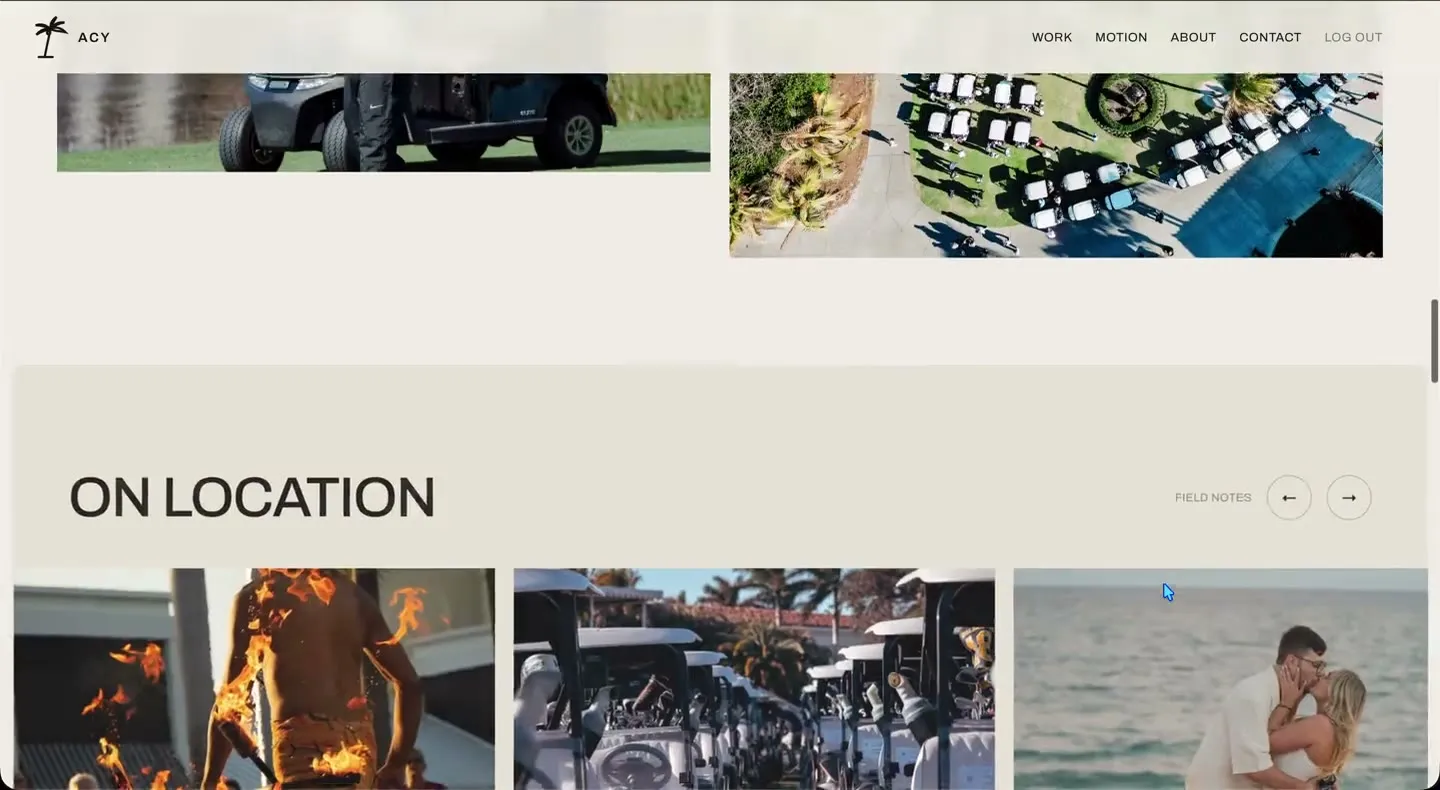
This is the part I can actually speak to with numbers instead of opinions. A portfolio I built for a photographer and videographer client (she goes by ACY publicly) loads in 1.9 seconds and scores 98 on Lighthouse performance. That is not a flex about me. It’s the baseline a gallery-heavy site has to hit before any of the marketing advice above matters, because a visitor on a phone will not wait for a hero image that arrives in pieces.
Google’s own guidance puts Largest Contentful Paint, how long until the biggest thing on screen finishes loading, at 2.5 seconds or less. Most photography sites I open are nowhere near it, and it’s almost always the same three causes: full-resolution JPEGs served straight to phones, a page builder loading a hundred kilobytes of JavaScript to draw a grid, and an autoplaying background video nobody asked for.
Export at the size you’ll actually display. Use modern formats. That alone usually fixes it.
How do you turn one client into three?
You ask. Directly, once, at the moment they’re happiest.
The happiest a client will ever be is the day you deliver the gallery. Not a month later, not in a newsletter. That day. One sentence at the end of the delivery email:
“If you know anyone else planning something like this, I’d love an introduction.”
That’s it. No referral program, no discount codes, no punch card. Photography is a trust purchase, and a personal introduction beats every ad you could buy.
The same goes for the vendors standing next to you at the job. Planners, florists, venues, videographers, hair and makeup. They are asked “do you know a good photographer?” constantly, and they will recommend whoever they actually enjoyed working with and can find again. Send them the gallery, tagged and usable, before they ask. You have just done their marketing for them, and they will remember it.
Where should photographers show up locally?
If you shoot anything local (weddings, families, headshots, real estate, events), Google Business Profile is the single highest-return hour you will spend, and it’s free.
Fill it out completely. Categories, service area, hours, and real photos of real work. Then ask past clients for reviews, because the local map results are ranked substantially on review volume and recency, and most photographers have four reviews from 2022.
Asking is a privilege, by the way. Therapists mostly can’t, which is why building trust without testimonials is its own post.
If you have a website, make sure the business name, address or service area, and phone number on it match the profile exactly, down to the formatting. Search engines cross-check them, and “Suite 4” on one and “Ste. 4” on the other is enough to muddy it. Adding LocalBusiness structured data to your site tells them explicitly rather than making them guess.
How much should you post on social media?
Less than you think, and more deliberately.
Instagram is a portfolio that people already have open. That’s its whole value. It is not a client-acquisition machine that rewards you for posting six times a week, and treating it like one is how photographers end up exhausted and still quiet.
Two things matter more than frequency:
- Your bio says what you shoot and where. Same rule as the website. “Long Beach wedding photographer” in the name field, not just the bio text.
- There is a link to somewhere you control. Social accounts get restricted, algorithms change, platforms decline. Your website doesn’t.
Post the work you want more of. Not the work you did most of. The feed trains people on what to ask you for, and if it’s full of the jobs you took to pay rent, that’s what you’ll keep being offered.
What did an overnight portfolio build actually look like?
The fastest one I’ve done was under 24 hours, and it’s the clearest example I have of why the website half of this matters.
ACY needed a portfolio for a job with less than a day’s notice. She sent photos and drone clips; I sent a design mockup within the hour; I stayed up past midnight finishing it, and the site was live before she woke up. Her words, not mine:
“I needed a portfolio site for a job with less than 24 hours of notice. Derek asked for my photos and drone clips and sent a design mockup within the hour — the layout was perfect. He stayed up past midnight to finish, and the site was live before I woke up. I added extra to the payment because he earned it.”
The reason that’s worth telling isn’t the speed. It’s that the thing standing between her and the job was not her photography. It was not having a single link that made her look like a professional. She already had the work. She needed somewhere to put it.
That gap is where most of the lost bookings live.
The short version
- Say what you shoot, in the words a client would search
- Cut the portfolio until only the best work is left
- Publish a starting price
- One obvious next step, not four
- Get the site loading in under 2.5 seconds
- Ask for the referral on delivery day
- Claim and fill out your Google Business Profile
- Post the work you want more of
None of this is clever. It’s just the stuff that gets skipped because it isn’t as fun as shooting.
Common questions
How long does it take to get more photography clients? Referrals and Google Business Profile can produce inquiries within weeks. Ranking in search for competitive terms takes months. Anyone promising you rankings on a timeline is guessing. The website fixes are the fastest, because they improve the conversion rate of traffic you’re already getting.
Do I need a website if I have Instagram? Yes, for one reason: you don’t own Instagram. Accounts get restricted and reach changes without warning. Your site is the one place a client can always find you, and it’s the only one that shows up in a Google search for what you shoot.
Should I put pricing on my photography website? At minimum a starting price. Clients comparing photographers skip the ones who won’t say, and you’d rather filter out the mismatches before the call than during it.
What’s the most common mistake on a photography website? Showing everything. A portfolio of nine genres reads as “available” rather than “excellent.” Pick the work you want more of and lead with it.
How fast should a photography site load? Under 2.5 seconds to render the largest element, per Google’s Core Web Vitals. It’s achievable with a gallery-heavy site (the one I mentioned above does 1.9 seconds), but not if you’re serving full-resolution exports to phones.
If the website half of this is the part you’ve been avoiding, that’s the part I do. I hand-code sites for small businesses in Long Beach and within about 25 miles, starting at $1,500, and most launch in one to two weeks. You can see the ACY portfolio build in full, look at what a site actually costs, or read more about web design in Long Beach.